Polish Fresh Blueberries – Technical Export Guide for hurtowe Buyers
Poland is a seasonal June–August origin for fresh northern highbush blueberries. For export buyers, the key decision factors are firmness, variety, bloom retention, cooling speed and route fit. Not every attractive large berry is suitable for long-distance transit — Chandler is the clearest example: visually impressive at 18–22 mm, but often too soft for demanding export routes.
This guide covers the technical and commercial layer that serious importers actually evaluate: size grading, Brix, firmness, anthocyanin content, shelf life, variety-by-variety differences, cold chain parameters, rejection risks and which parameters matter most for fresh and industrial applications. For seasonal availability, packaging formats and dispatch programs, see the Polish blueberries export program page.
Who this guide is for
- Importers evaluating Polish blueberries for the first time
- Distributors and wholesalers planning summer fresh programs
- Retailers and foodservice buyers specifying variety and firmness requirements
- Food manufacturers comparing fresh vs IQF for dairy, bakery and beverage applications
- Cold-chain logistics buyers assessing route fit and shelf-life risk
Key parameters at a glance
Season: June – August (Poland)
Storage temperature: 0–2°C
Relative humidity: 90–95% RH
Shelf life from harvest: 14–28 days under good postharvest conditions
Typical Brix: 10–16°Bx depending on variety and maturity
Anthocyanins: 100–300 mg/100 g fresh weight (variety and assay dependent)
Key varieties: Duke, Spartan, Bluecrop, Chandler, Toro, Patriot, Liberty, Darrow
Export standard: UNECE standard for blueberries and bilberries
Technical Parameters of Export-Grade Polish Highbush Blueberries
Berry size and export grading
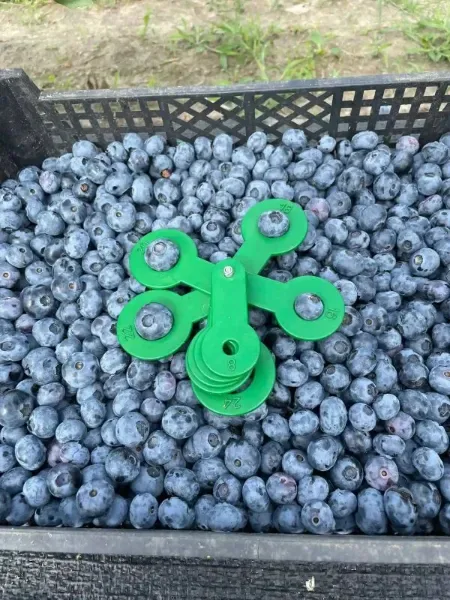
For fresh export, berry size is described by diameter in millimetres. Commercial sizing ranges widely used for northern highbush blueberries:
- Medium: approximately 12–14 mm
- Large: approximately 14–18 mm
- Jumbo: 18 mm and above
Most established Polish cultivars — Duke, Bluecrop, Spartan, Liberty — typically fall in the large class under good orchard management. Chandler regularly reaches jumbo sizing (18–22 mm) but carries higher softness risk. Size alone does not guarantee export suitability.
Brix — soluble solids at export maturity
At export maturity, fresh northern highbush blueberries typically show soluble solids in the range of approximately 10–16°Bx, with meaningful variation by cultivar, weather and maturity at picking. Brix matters as a maturity and flavour indicator for fresh buyers and as a direct formulation input for food manufacturers. Importers should not judge a lot by Brix alone — acidity balance and aromatic expression are equally relevant.
Firmness
Firmness is one of the most critical export parameters — it determines shelf life, bruising tolerance and suitability for longer transit. Assessed either instrumentally through compression and texture analysis, or using Durofel-type non-destructive indexing in commercial programs. There is no single global legal threshold, but commercial and breeding literature consistently identifies firmness as a top priority for exportable fruit. Duke and Liberty are generally positioned as firmer cultivars for longer transit; Chandler is often too soft for demanding export routes despite its impressive size.
pH and titratable acidity
Highbush blueberries typically show pH approximately 3.0–3.5 with titratable acidity around 0.4–1.0% depending on variety, maturity and analytical method. For food manufacturers, acidity affects flavour brightness, stability in dairy and beverage systems, and the sugar or balancing ingredient needed in the final formula.
Anthocyanins — relevance for food manufacturing
Published work on highbush blueberries commonly reports total anthocyanins in the range of approximately 100–300 mg per 100 g fresh weight, with large variation by cultivar, maturity, environment and analytical method. For food manufacturers, anthocyanin content delivers: stronger natural colour potential in yogurt, beverages and fruit preparations; higher perceived functional value in wellness-oriented products; and better fit for clean-label positioning where natural fruit colour replaces artificial colour systems. Any health claim used in the EU must comply with authorised EU nutrition and health claim regulations (EC 1924/2006).
Bloom — the freshness signal
Bloom is the natural waxy coating visible on the berry surface. A strong, even bloom signals careful handling and freshness — easily damaged by rough picking, poor packaging friction or condensation. Buyers associate heavy bloom with freshness and lower handling damage. Fruit with weak bloom frequently receives complaints even when internal quality remains acceptable.
Shelf life in cold storage
Under good postharvest conditions — 0–2°C and 90–95% RH — fresh blueberries typically maintain commercial life for around 14–28 days from harvest, depending on variety, cooling speed and packaging format. The marketable window shortens rapidly if berries are harvested warm, picked overripe, slow-cooled, packed wet or exposed to temperature abuse.
Premature softening
Driven by over-maturity at harvest, high field heat, delayed cooling, excess moisture and mechanical damage. Once firmness loss begins it cannot be reversed. The first 12–24 hours after harvest often matter more than the last 48 hours before arrival. Fast pre-cooling and stable cold chain from field to packhouse are core shelf-life management tools, not optional details.
Variety Comparison – What Matters for Trade Buyers
Polish production is built largely on traditional northern highbush cultivars. Performance varies by orchard, crop load, region and season — variety data below reflects commercial ranges and relative export behaviour rather than guaranteed fixed values.
| Variety | Harvest window (Poland) | Typical size | Export strength | Best fit |
|---|---|---|---|---|
| Duke | Week 26–28 | 14–18 mm | Firmness, early season | Fresh retail, road freight, air freight |
| Spartan | Week 27–29 | 16–20 mm | Flavour, premium appearance | Premium fresh, shorter transit |
| Bluecrop | Week 28–31 | 14–18 mm | Versatility, reliability | Wholesale, road freight, retail |
| Chandler | Week 29–32 | 18–22 mm | Display size, visual impact | Short-chain premium retail, HoReCa only |
| Toro | Week 28–30 | 14–18 mm | Bunch architecture | Regional fresh retail, local wholesale |
| Patriot | Week 27–29 | 14–18 mm | Early availability | Regional fresh retail, wholesale |
| Liberty | Week 31–34 | 14–18 mm | Late season window | Lot-by-lot evaluation — check firmness |
| Darrow | Late mid-season | 16–20 mm | Size in older plantings | Assess as individual lot |
Polish highbush vs wild lowbush
Polish export blueberries are cultivated northern highbush blueberries (Vaccinium corymbosum), grown in commercial orchards. Lowbush berries are smaller, more intensely coloured and compositionally distinct — sometimes preferred in processing where very intense colour or smaller inclusion size is needed. For most fresh retail, HoReCa and standard dairy manufacturing, highbush is the correct commercial product category.
Export Markets and What Importers Require
Germany, UK, Netherlands
Most logical markets for Polish fresh blueberries due to route proximity, summer demand and established retail and wholesale channels. Importers typically require GlobalG.A.P., full traceability, residue compliance under EU MRL regulation, cold chain discipline and pack consistency. Without GlobalG.A.P., access to structured EU retail channels is sharply limited.
UAE and Gulf
Attractive for premium fresh programs but requires high-grade fruit with strong firmness and preserved bloom. Air freight is often preferred. Fruit must be fast-cooled and loaded with strong remaining shelf life given heat exposure risk at destination.
Nigeria and West Africa
Commercial demand for imported fresh blueberries is narrow — a niche premium product at best for modern retail or affluent urban HoReCa. IQF blueberries are often more commercially realistic for broader-volume use cases where infrastructure and cold-chain continuity are limiting factors.
Morocco
More relevant as a regional commercial node than a major destination for imported Polish blueberries. Route economics and local seasonal competition must be assessed per program.
Vietnam and Southeast Asia
Air-freight premium programs are the logical fit. Vietnam operates with formal protocol-driven import conditions that must be met before shipment — treat as a document-dependent program, not an open standard shipment.
Regulatory and certification framework
- UNECE quality framework — export-stage quality standard for blueberries and bilberries
- EU MRL compliance — legal requirement for all EU shipments; retailers often apply stricter private limits
- GlobalG.A.P. — practical retail market-access standard for Germany, UK, Netherlands
- Phytosanitary certificates — market-specific documentation required for non-EU destinations
Typical rejection causes at destination
- Soft fruit or collapse — weak initial firmness or poor temperature control at harvest
- Decay — condensation, delayed cooling or wet fruit creating fungal pressure in transit
- Poor bloom retention — fruit appearing overhandled or old
- Shrivelling — moisture loss from low humidity during storage or transit
- Residue or documentation issues — MRL exceedances or missing certificates
Cold Chain – Specific Parameters
Temperature
- Optimal: 0–2°C. Above this, respiration, softening and decay risk increase rapidly.
- Below target: tissue damage if fruit freezes — practical handling aims for close-to-zero, not sub-zero abuse.
Relative humidity
- Optimal: 90–95% RH.
- Too low: shrivel, weight loss, weaker bloom.
- Too high / condensation: fungal risk rises, especially if fruit was packed warm.
Blueberries need high RH but dry fruit surface and good airflow — not simply maximum moisture.
Ethylene
Blueberries are low ethylene producers compared with climacteric fruit like apples or bananas. Mixed-cargo situations introducing avoidable ripening risk should still be avoided.
Modified Atmosphere Packaging (MAP)
MAP can extend marketable life in retail punnets. Typical commercial MAP ranges for berries target reduced O₂ and elevated CO₂ — broadly 5–15% O₂ and 10–20% CO₂, depending on film, pack format and temperature control.
Commercial cold storage hold
Practical commercial window: typically up to 2–4 weeks from harvest under good conditions. Quality deterioration becomes commercially relevant well before the theoretical maximum if the lot starts weak.
Air freight cold chain
Critical sequence: harvest cool → fast packhouse movement → prompt forced-air pre-cooling → stable low-temperature holding → minimised apron exposure before loading. Berries must arrive at the aircraft already cold. Air freight speed does not compensate for poor pre-cooling.
Food Manufacturing Applications
Dairy — yogurt, ice cream, dairy desserts
Manufacturers care about anthocyanin level for colour potential, Brix and acid balance for flavour, skin integrity and firmness for whole-berry inclusions, and size consistency in premium dairy lines. IQF is often more practical for stirred yogurt, fruit preparations and frozen dessert inclusions; fresh is more relevant where visible premium matters.
Bakery — muffins, fillings
IQF often performs better when berries must survive mixing, freezing or baking with controlled cost and year-round availability. Fresh is more relevant for seasonal premium placement.
Juice and smoothies
Brix and anthocyanins matter most — Brix for sweetness and flavour balance, anthocyanins (100–300 mg/100 g fresh weight depending on cultivar) for colour intensity and perceived functional value.
Nutraceuticals and functional products
Blueberries are relevant to functional concepts because of anthocyanins and polyphenols. Any health claim in the EU must comply with authorised regulations (EC 1924/2006).
Why Polish blueberries are competitive vs distant origins
Strong June–August European seasonality; short logistics to Germany, UK, Netherlands; fresher arrival with lower transit fatigue; lower cold-chain risk than long-haul imported fruit during the same period. For non-EU markets, Poland remains competitive where buyers want European summer origin, correct documentation and premium short-season supply.
What Buyers Should Request Before Quotation
The following checklist covers the information MG SALES needs to provide an accurate quotation and realistic shelf-life assessment — and what any serious buyer should request from any supplier before committing to a blueberry export program.
- Variety — not just "highbush"; specific cultivar matters for firmness and transit planning
- Harvest date — defines remaining commercial life for the planned route
- Berry size range in mm — not just a grade name; actual measured range
- Firmness reading or assessment method — Durofel index, compression test or equivalent
- Brix — lot-specific value, not a generic varietal claim
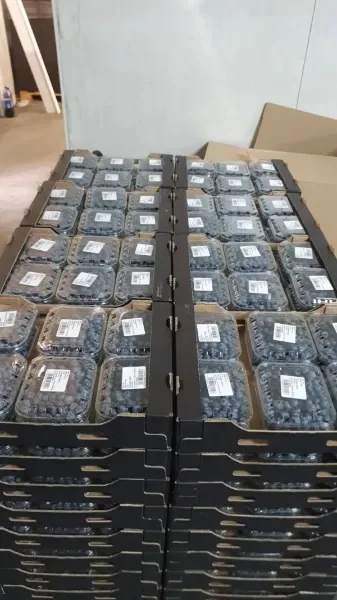
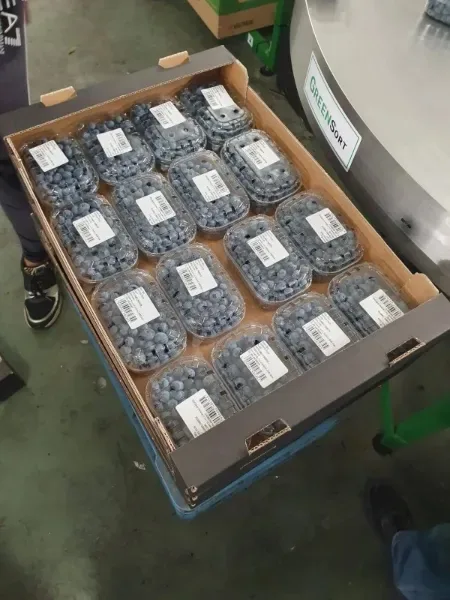
- Pack format — 125 g / 500 g / 1 kg punnets or 3 kg loose
- Cold-chain profile — time from harvest to pre-cooling, storage temperature log
- Certification status — GlobalG.A.P. number, residue testing summary
- Target market and logistics mode — road freight EU vs air freight non-EU
- Intended use — fresh retail, HoReCa, food manufacturing or IQF processing
See our Polish blueberries export program page for packaging formats, dispatch model and seasonal availability details.
Frequently Asked Questions – Polish Blueberry Export
How much shelf life should fresh Polish blueberries have on arrival?
Under good postharvest conditions — 0–2°C and 90–95% RH — fresh blueberries typically maintain commercial life for around 14–28 days from harvest. Remaining shelf life on arrival depends on variety, harvest date, cooling speed and route. Softening usually starts before shipment — a short transit cannot rescue fruit that was already losing firmness before entering the cold chain.
Which quality parameters should I request before buying fresh Polish blueberries?
Request: variety name, harvest date, berry size range in mm, firmness assessment, Brix (°Bx), pack format, bloom quality photos, temperature history from harvest to dispatch, residue compliance under EU MRL regulation, and the cold-chain profile from packhouse to arrival. For EU retail programs, GlobalG.A.P. certification is a practical market-access requirement.
Which Polish blueberry varieties are best for long-distance export?
Duke (harvest week 26–28) is one of the safest early export cultivars due to firmness and reliability. Bluecrop (week 28–31) is broadly versatile for road freight and wholesale. Chandler (week 29–32) produces 18–22 mm fruit but is often too soft for demanding long-distance routes. Liberty (week 31–34) should be assessed lot-by-lot for firmness. For air-freight premium programs, firmer varieties such as Duke and selected Spartan lots are generally most suitable.
What is the difference between highbush and lowbush blueberries for food manufacturing?
Polish export blueberries are cultivated northern highbush blueberries (Vaccinium corymbosum) — larger and better suited to fresh retail with broader uniform supply. Lowbush berries are smaller and more intensely coloured, which can be attractive in processing where very intense colour or smaller inclusion size is needed. For most fresh retail, HoReCa and standard dairy manufacturing, highbush is the correct commercial product category.
Is GlobalG.A.P. mandatory for EU blueberry buyers?
Not universally mandatory by law, but for most organised retail chains and professional wholesale programs in Germany, UK and the Netherlands, GlobalG.A.P. is effectively a market-access requirement. Without it, access to structured EU retail channels is sharply limited. Residue compliance under EU MRL regulation is a separate legal requirement that applies regardless of certification status.
Can Polish blueberries be exported outside the EU?
Yes, but each non-EU market requires market-specific documentation and phytosanitary compliance. Vietnam operates with formal protocol-driven import conditions. Gulf markets require full cold-chain continuity and specific documentation. Contact MG SALES to confirm requirements for your specific destination.
When should I buy fresh blueberries and when is IQF the better option?
Fresh is the right choice when visual premium, retail presentation and whole-berry eating quality matter — EU retail, premium HoReCa and short-chain programs during the Polish season. IQF is better for food manufacturing, year-round industrial supply (yogurt, ice cream, bakery, smoothies) or markets where fresh cold-chain continuity is weaker. For Nigeria and much of West Africa, IQF is often more commercially realistic than fresh imported blueberries.
Why do blueberries sometimes arrive soft even when transit was short?
Softening starts before shipment — caused by over-maturity at harvest, high field heat, delayed cooling, excess moisture or varietal weakness. Once firmness loss begins it cannot be reversed. The first 12–24 hours after harvest often matter more than the last 48 hours before arrival. Fast pre-cooling and stable 0–2°C from packhouse to destination are essential — short transit alone cannot compensate for poor postharvest handling.
Frequently Asked Questions — Polish Blueberry Varieties
How much shelf life should fresh Polish blueberries have on arrival?
Under good postharvest conditions — storage at 0–2°C and 90–95% RH — fresh blueberries maintain commercial life for 14–28 days from harvest. Remaining shelf life on arrival depends on variety, harvest date, cooling speed and route.
| Transport mode | Usable shelf life on arrival | Notes |
|---|---|---|
| Reefer truck (EU) | 10–14 days commercial window | MG SALES standard for EU buyers |
| Air freight (non-EU) | 3–5 days commercial window | Premium lots only — Warsaw departure |
| Sea freight | Not offered | Transit time makes it commercially non-viable |
Softening usually starts before shipment. Short transit cannot rescue fruit that was already losing firmness before entering the cold chain.
Which Polish blueberry varieties are best for long-distance export?
| Variety | Harvest week | Berry size | Export suitability |
|---|---|---|---|
| Duke | Week 26–28 | 14–18 mm | Best for long-distance — firm, reliable early cultivar |
| Spartan | Week 27–29 | 14–18 mm | Good for air freight premium programs (selected lots) |
| Bluecrop | Week 28–31 | 14–18 mm | Versatile — road freight and wholesale programs |
| Chandler | Week 29–32 | 18–22 mm | Large berry but often too soft for demanding long routes |
| Liberty | Week 31–34 | 14–18 mm | Assess lot-by-lot for firmness before long transit |
Which quality parameters should I request before buying fresh Polish blueberries?
A serious buyer should request the following before confirming an order:
- Variety name and harvest date
- Berry size range in mm (Class I min 12 mm per UNECE standard)
- Firmness assessment method and result
- Brix (°Bx) — min 10 °Bx for highbush varieties
- Photos of bloom quality (intact bloom = freshness indicator)
- Temperature history from harvest to dispatch (max 2°C at loading)
- Residue compliance status under EU MRL regulation (EC 396/2005)
- GlobalG.A.P. certification status (required for EU retail channels)
Is GlobalG.A.P. mandatory for EU blueberry buyers?
Not universally mandatory by law, but for most organised retail chains and professional wholesale programs in Germany, UK and the Netherlands, GlobalG.A.P. is effectively a market-access requirement. In practical hurtowe trade, the absence of GlobalG.A.P. sharply limits access to structured EU retail channels.
Residue compliance under EU MRL regulation (EC 396/2005) is a separate legal requirement that applies regardless of certification status.
When should I buy fresh blueberries and when is IQF the better option?
| Use case | Fresh | IQF |
|---|---|---|
| EU retail / premium HoReCa | ✓ Best choice | Not suitable |
| Short-chain programs (season) | ✓ Best choice | Alternative |
| Food manufacturing (yoghurt, ice cream, bakery) | Limited | ✓ Best choice |
| Year-round industrial supply | Not possible | ✓ Best choice |
| West Africa / Nigeria | Difficult logistics | ✓ More realistic |
| Smoothie / juice manufacturing | Limited | ✓ Best choice |
What is the difference between highbush and lowbush blueberries for food manufacturing?
Polish export blueberries are cultivated northern highbush blueberries (Vaccinium corymbosum) — larger berries (12–22 mm), better suited to fresh retail and capable of broad uniform supply. Key differences:
- Highbush: 12–22 mm, milder flavour, suited to fresh retail, HoReCa and standard dairy manufacturing
- Lowbush: smaller and more intensely coloured — attractive in processing applications where intense colour or smaller inclusion size is needed
For most fresh retail, HoReCa and standard dairy manufacturing, highbush is the correct commercial product category. Anthocyanin content in highbush: 100–300 mg/100g depending on variety and season.
Why do blueberries sometimes arrive soft even when transit was short?
Softening usually starts before shipment — not during transit. Common causes:
- Over-maturity at harvest
- High field heat — delayed cooling after picking
- Delayed cooling — first 12–24 hours after harvest matter most
- Excess moisture on fruit surface
- Varietal weakness (Chandler, late Liberty lots)
Once firmness loss begins it cannot be reversed. Fast pre-cooling and stable 0–2°C from packhouse to destination are essential. Short transit cannot compensate for poor postharvest handling in the first hours after harvest.
Can Polish blueberries be exported outside the EU?
Yes, but each non-EU market requires market-specific documentation and phytosanitary compliance:
- Gulf markets (UAE, KSA): full cold-chain continuity required, specific import documentation, Halal certificate available on request
- Vietnam: formal protocol-driven import conditions — contact us to confirm current requirements
- West Africa: air freight from Warsaw; IQF often more commercially realistic than fresh
- India: phytosanitary certificate per NPPO India requirements, import permit required
MG SALES handles export documentation for non-EU destinations on a program basis.
Related Pages
- Polish blueberries export program – packaging formats, dispatch and seasonal supply
- Apple shelf life – storage and transport guide for export
- Fresh apples export from Poland – varieties, packaging and logistics
- Apple quality control – pre-shipment QC and transit risk assessment
- Contact MG SALES – start a blueberry export program